

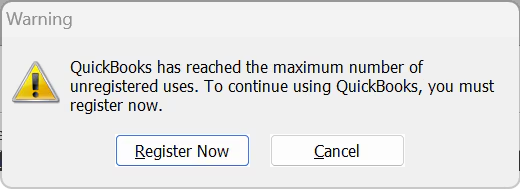
The “QuickBooks Maximum Unregistered Uses” error prevents users from opening QuickBooks Desktop (QBD) and accessing company files. This issue arises when the software detects that an installation has exceeded its allowed number of unregistered launches.
QBD enforces licensing limits through this mechanism. It requires valid product and license numbers linked to an Intuit account for continued use. Small and midsize businesses rely on QuickBooks for invoicing, payroll, and financial reporting, so this error disrupts essential operations until resolved.
In this article, you will get a complete guide to resolve “Maximum Number of Unregistered Uses” Error in QuickBooks Desktop, along with its triggers, impacts, prerequisites, and preventive tips.
Table of Contents
- 1 What Triggers “Maximum Number of Unregistered Uses” Error in QuickBooks
- 2 Initial Verification Steps
- 3 How to Fix “Maximum Number of Unregistered Uses” Error in QuickBooks
- 4 Prevention for Businesses
- 5 Registration Errors vs. Usage Limits
- 6 Conclusion
- 7 Frequently Asked Questions
- 7.1 Why is QuickBooks asking for registration again after working previously?
- 7.2 How do I check whether my QuickBooks license is valid?
- 7.3 Does changing computers affect QuickBooks activation status?
- 7.4 Can an incorrect system date and time cause validation failures?
- 7.5 What should businesses track to avoid licensing disruptions?
What Triggers “Maximum Number of Unregistered Uses” Error in QuickBooks
QuickBooks Desktop enforces licensing limits by tracking unregistered launches. This error typically stems from one of these key issues:
- QuickBooks tracks unregistered launches and blocks access after the limit to enforce Intuit’s licensing requirements.
- The trial period expired without proper registration, triggering the restriction.
- The same license was activated on multiple computers beyond the permitted limit.
- Corrupted local registration files, often due to malware or incomplete updates, fail to validate against Intuit servers.
- System changes or Windows issues damaged registration files, preventing license verification.
Initial Verification Steps
Users complete several checks before attempting fixes:
- First, identify the exact QuickBooks Desktop version and edition, such as 2025 Pro or Enterprise.
- Next, retrieve the license number and product number from the original purchase email, packaging, or Intuit account profile.
- Ensure the computer maintains a stable internet connection, as registration communicates with Intuit servers online.
- Finally, verify that the system date and time settings match the local time zone accurately, since discrepancies interfere with secure validation processes.
Struggling With Accounting or Bookkeeping?
Talk to our experts in minutes — No wait time!
- Free Consultation
- Fast Response
- Trusted Experts

How to Fix “Maximum Number of Unregistered Uses” Error in QuickBooks
Solution 1: Register QuickBooks Directly
Use this to manually validate your software by entering your official credentials into the registration prompt. Follow these steps to register QuickBooks:
- Open QuickBooks and respond to the registration prompt when it appears.
- Select the Register Now option from the dialogue box.
- Enter the Intuit account credentials associated with the purchase.
- Input the license number and product number exactly as they appear in purchase records.
- Complete the online verification process, which confirms the details against Intuit’s database.
- Restart QuickBooks after registration finishes to verify that the software launches without the error message.
Solution 2: Sync License Data Online
Forces a fresh connection with Intuit’s servers to update your entitlement status and resolve sync errors. Use these steps to synchronize license data:
- Access the Help menu in QuickBooks and select Manage My License.
- Choose the Sync License Data Online option from the submenu.
- Allow the software to connect to Intuit automatically and update entitlement information.
- Close QuickBooks completely after the process completes.
- Reopen QuickBooks to confirm the resolution.
Solution 3: Remove Extra Installations
Essential if you have exceeded your seat limit and need to revoke access from old or unused workstations. Complete these actions to eliminate extra installations:
- Review all devices that currently use the same license and product numbers.
- Uninstall QuickBooks from any machines that no longer require access, using the standard Windows uninstaller found in Control Panel.
- Where available, deactivate the license through the Help menu on those systems before removal.
- Reactivate QuickBooks on the primary computer afterwards.
Solution 4: Reset Registration Files
Clears out corrupted license data by renaming the Entitlement folder, triggering the creation of a clean file. Reset corrupted files using this process:
- Close QuickBooks fully.
- Navigate to the folder containing version-specific entitlement files, typically located in C:\ProgramData\Intuit\Entitlement Client\v8 (or v6, depending on version).
- Rename the files according to Intuit’s instructions for the installed version, usually appending .old to the filename.
- Reopen QuickBooks, which generates new files automatically.
- Enter the license and product numbers to complete registration again.
Solution 5: Repair the Installation
Targets underlying software glitches or missing system components through the Windows Control Panel. Repair damaged components through these steps:
- Open the Control Panel and navigate to Programs and Features.
- Locate the QuickBooks entry in the list, right-click it, and select Change or Repair.
- Choose the Repair option and follow the prompts to restore files.
- Restart the computer after the repair completes.
- Launch QuickBooks and attempt registration.
You may also read this: QuickBooks DSN File: File Extension, and How to Use It?
Prevention for Businesses
Follow these tips to avoid facing ‘QuickBooks Unregistered Uses’ error in future:
- Maintain a central record of all QuickBooks licenses used in your business.
- List each computer with its corresponding license number and product number in a secure spreadsheet.
- Deactivate the QuickBooks license as soon as you retire, replace, or repurpose a device.
- Download and install updates only from official Intuit channels to avoid corrupt or unsafe files.
- Run scheduled antivirus scans on all systems that host QuickBooks to protect registration and entitlement files.
- Review all active installations at least once every quarter to confirm they match your license terms.
Registration Errors vs. Usage Limits
The “QuickBooks unregistered uses error” applies specifically to QuickBooks Desktop licensing and activation. QuickBooks Online uses different mechanisms, displaying “QuickBooks usage limit reached” messages when subscriptions exceed user counts, chart of accounts entries, classes, or locations based on the plan tier. Desktop errors involve product keys and local files, while Online issues relate to subscription parameters. Users confirm the product type before applying fixes to avoid ineffective troubleshooting.
Conclusion
The QuickBooks maximum unregistered uses error results directly from exceeded trial launches, multi-device license overuse, or corrupted local files. Users address it through direct registration, online synchronisation, installation cleanup, file resets, repairs, or Intuit support as needed. Each method targets a specific cause and restores access systematically. Businesses that track licenses diligently, verify details before changes, and maintain system stability encounter this issue infrequently. Accurate financial records remain accessible, supporting uninterrupted operations and compliance with licensing requirements.
Frequently Asked Questions
Why is QuickBooks asking for registration again after working previously?
QuickBooks may ask for registration again when license files are damaged, system changes happen, or activation details fail to sync properly.
How do I check whether my QuickBooks license is valid?
Check license and product numbers in QuickBooks account details and verify activation status through your official Intuit account profile.
Does changing computers affect QuickBooks activation status?
Installing QuickBooks Desktop on a new computer without deactivating the previous system can exceed seat limits and trigger activation errors.
Can an incorrect system date and time cause validation failures?
Incorrect Windows date and time settings can block QuickBooks from connecting to servers and completing license verification.
What should businesses track to avoid licensing disruptions?
Businesses should keep license details safe, track installed devices, and review QuickBooks usage regularly to avoid activation problems.